A 100-year flood can happen again next year
Back to the guideA return period is a way to express an estimated annual exceedance probability, not a timetable. This worked explanation uses a simplified model to show why several years of exposure matter. It does not estimate risk for a particular property.
- Identify the event threshold and the source of its probability estimate. Flood depth, river flow and rainfall totals describe different thresholds; a label without one is incomplete.
- For an annual exceedance probability p, the reciprocal return period is T = 1/p. Thus p = 0.01 corresponds to 100 years in this terminology, not a guaranteed interval.
- Under constant probability and independent annual outcomes, the chance of at least one exceedance in n years is 1 − (1 − p)^n. State these assumptions beside the calculation.
- Before a local decision, obtain current flood mapping and advice relevant to the site. Ask about uncertainty, changing conditions and the event definition rather than treating this example as a parcel assessment.
| Field | Example or check |
|---|---|
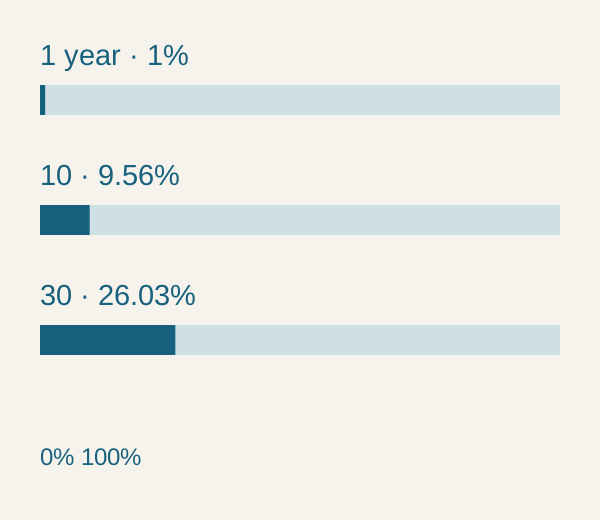
| One year | p = 0.01: a 1% annual chance of exceeding the specified threshold. |
| Ten years — simplified model | 1 − 0.99^10 ≈ 9.56% for at least one exceedance. |
| Thirty years — simplified model | 1 − 0.99^30 ≈ 26.03% for at least one exceedance. |
| After an event | The model does not introduce a 99-year safe waiting period. Under its assumptions, next year still has a 1% chance. |
| Questions for a local assessment | Threshold __; source and date __; location __; model uncertainty __; changing exposure __; professional/local authority advice __. |
Annual independence and a constant p are modelling assumptions, not a claim that climate, catchments or flood estimates stay fixed. A probability is not a promise about the next event.