The worked example
With 800 mm of precipitation, 450 mm of evapotranspiration and 300 mm of runoff over the same period, the storage residual is 800 − 450 − 300 = 50 mm. Over 10 km², that equals 50 × 10 × 1,000 = 500,000 m³.
Keep the calculation beside the module catalogue and the hydrology reading. Write down what the model includes, what it leaves out and where each input came from. A numerical result alone does not validate an input or establish a measured catchment balance.
Why the unit conversion works
1 mm = 0.001 m and 1 km² = 1,000,000 m². Their product is 1,000 m³. Use one time period and one catchment boundary for all inputs.
Read the residual carefully
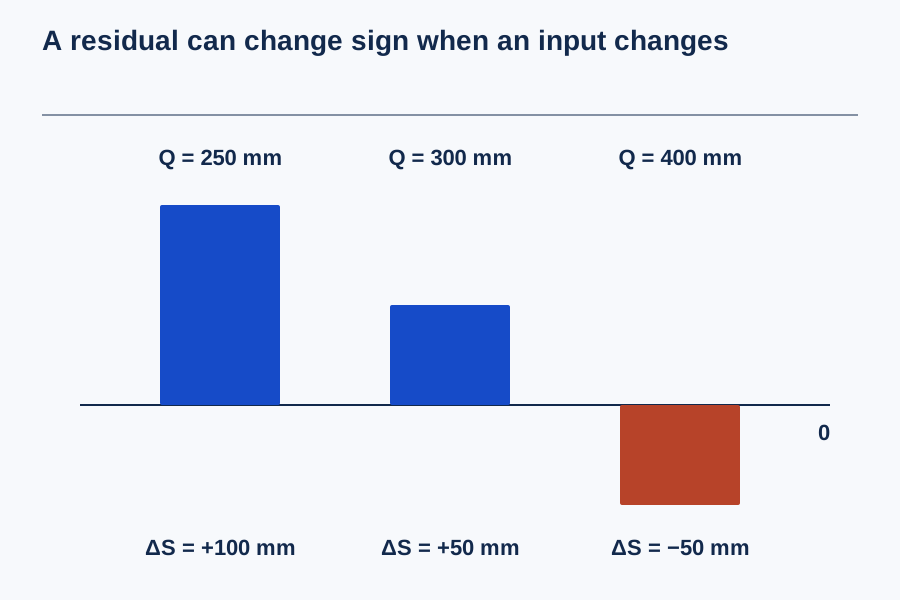
A negative balance can indicate storage depletion or incomplete inputs; it is not automatically an error. A zero residual means inputs and outputs balance in the simplified model. Water imports, abstractions, groundwater exchange and measurement uncertainty may require additional terms.
Assumptions and source
This is a closed-boundary teaching example, not a flood prediction, water availability forecast or engineering design tool. Its inputs are illustrative. The conservation of water follows the water-budget framework described by the USGS Circular 1308: Water Budgets. For a real assessment, define boundaries, measure flows and evaluate uncertainty.
Before calculating: a boundary card and four acceptance checks
The equation needs a consistent boundary before it needs a precise number. Write down the catchment, observation period and which transfers are excluded. These fictional acceptance cases let you distinguish a legitimate negative residual from an invalid input.
- Choose one catchment and one period for precipitation P, evapotranspiration ET and runoff Q. Use depths in millimetres and catchment area in square kilometres. Annual precipitation and monthly runoff cannot share one residual.
- List transfers that the three-term model omits: imports, abstractions or groundwater exchange may matter. The residual cannot identify which omitted process occurred.
- Run the four cases below. Positive, zero and negative residuals are all allowed. A negative precipitation or a zero area is invalid for this teaching tool; correct it before interpreting a number.
- Save the inputs and output together. When using real measurements, record their uncertainty and sampling period. Additional decimal places in the output do not increase the quality of the observations.
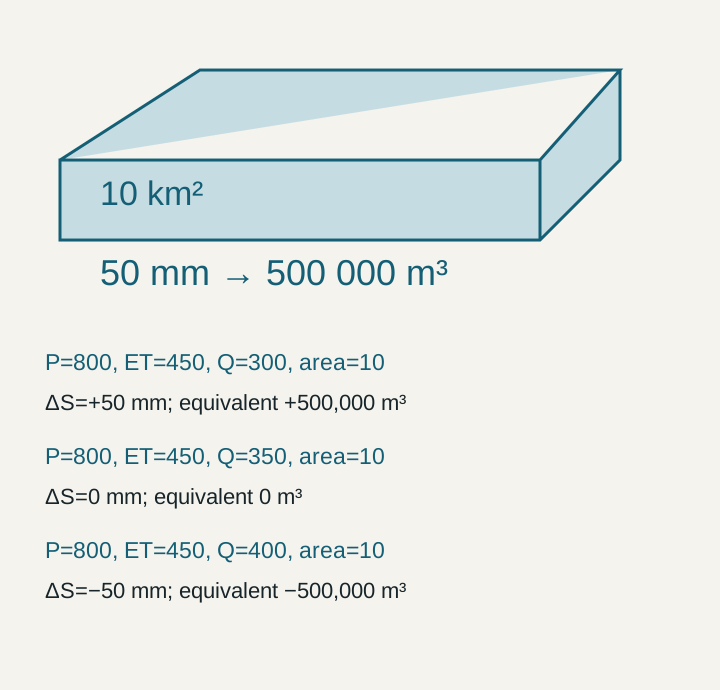
Diagram text: P=800, ET=450, Q=300, area=10: ΔS=+50 mm; equivalent +500,000 m³; P=800, ET=450, Q=350, area=10: ΔS=0 mm; equivalent 0 m³; P=800, ET=450, Q=400, area=10: ΔS=−50 mm; equivalent −500,000 m³
| Field | Example or check |
|---|---|
| P=800, ET=450, Q=300, area=10 | ΔS=+50 mm; equivalent +500,000 m³ |
| P=800, ET=450, Q=350, area=10 | ΔS=0 mm; equivalent 0 m³ |
| P=800, ET=450, Q=400, area=10 | ΔS=−50 mm; equivalent −500,000 m³ |
| P=−1 or area=0 | Invalid input; no interpreted balance |
| Unit check | 1 mm × 1 km² = 1,000 m³; 50 × 10 × 1,000 = 500,000 |
The worked cases test arithmetic and input handling. They do not validate a real catchment, predict flooding or establish sustainable withdrawals. If your boundary contains an unmeasured transfer, record that limitation beside the residual rather than silently treating the transfer as zero.
Keep a missing input separate from a measured zero
An empty box means that a required input has not been supplied. Zero is a supplied number. Replacing an unknown precipitation observation with zero changes the meaning of the water balance, even when the arithmetic then looks precise.
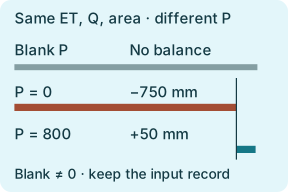
- Use the first calculator above. Keep ET = 450 mm, Q = 300 mm and area = 10 km². Clear the precipitation field, then select Calculate. The required-field check should prevent a new numerical result. Keep the missing input unresolved.
- Enter P = 0 explicitly and calculate again. The teaching equation gives 0 − 450 − 300 = −750 mm, equivalent to −7,500,000 m³ over 10 km². This is a valid signed calculation for the entered model, not evidence that zero rainfall was observed.
- Enter P = 800 and recalculate: +50 mm and +500,000 m³. Record the new input set alongside the result. A result from the previous inputs must not be copied as the output of an incomplete new attempt.
Boundary checks: leave area empty, then try area = 0. Neither supplies a valid positive catchment area for this tool. Restore area = 10 before comparing the two complete cases. An input error does not invalidate the conservation equation; it prevents this particular calculation from being interpreted.
Worksheet: boundary ___; common observation period ___; P value or “missing” ___; ET ___; Q ___; area ___; validation outcome ___; result for these exact inputs ___; evidence supporting a claimed zero ___. These numbers are invented classroom inputs. Missing transfers, uncertainty and the limits of the three-term model described above still apply.